
Sherwood City Directory Collection Checkpoints
The documented starting point is Sherwood Public Library, a WCCLS member with a public catalog and a librarian-assisted inquiry route. The sources reviewed did not publish a Sherwood city-directory publisher, issue run, reverse section, telephone-book run, obituary index, microfilm run, or digitized directory. That is important collection information in its own right. Ask staff to search Sherwood, Washington County, city-directory, telephone-directory, numerical-directory, and reverse-directory subject terms, then inspect the actual item before treating it as local coverage.
| Research channel | Known coverage | Where to begin | Safe access step |
|---|---|---|---|
| Sherwood Public Library and WCCLS catalog | Current catalog, with no local directory run published in the reviewed sources | 22560 SW Pine St., Sherwood | Ask a librarian to confirm a title, geography, and issue before relying on it. |
| In-library genealogy access | A 2023 library program documented in-library Ancestry access | Sherwood Public Library | Use it as a research gateway, not as evidence of a specific directory holding. |
| Oregon State Archives | Historic vital, census, and county-record series vary by collection | Reference Room or research-service route | Provide a name, event date, city, and county for a series-specific inquiry. |
| Washington County Historical County Records Guide | Series-dependent inventories, cutoffs, and restrictions | Oregon State Archives online guide | Check the relevant record series before assuming it is digitized. |
The table is deliberately a route map rather than a directory chronology. It separates verified access points from shelf details that still need confirmation.
Sherwood City Directory Research at the Library Desk
Sherwood Public Library is a concrete place to begin: it is at 22560 SW Pine St., its public site provides a catalog entry point, and its published hours cover all seven days. The library began as a drugstore shelf in 1935, received city support in 1969, joined WCCLS in 1976, and moved into the joint Library and City Hall facility in 2005. Those milestones explain why a local-history question may involve catalog holdings, staff referrals, or material held elsewhere in the cooperative rather than one claimed shelf.
The published schedule gives a practical way to make that inquiry: Monday through Wednesday, 10 a.m. to 7 p.m.; Thursday and Friday, 11 a.m. to 6 p.m.; Saturday, 10 a.m. to 6 p.m.; and Sunday, 1 p.m. to 5 p.m. Ask the librarian to check separate catalog headings for local history, city and telephone directories, numerical or reverse volumes, yearbooks, obituary material, newspapers, maps, and genealogy resources. The 2023 program notice supports in-library Ancestry access, but not a claim that a particular Sherwood item is in that service.
The City of Sherwood history page records the local setting behind this work.
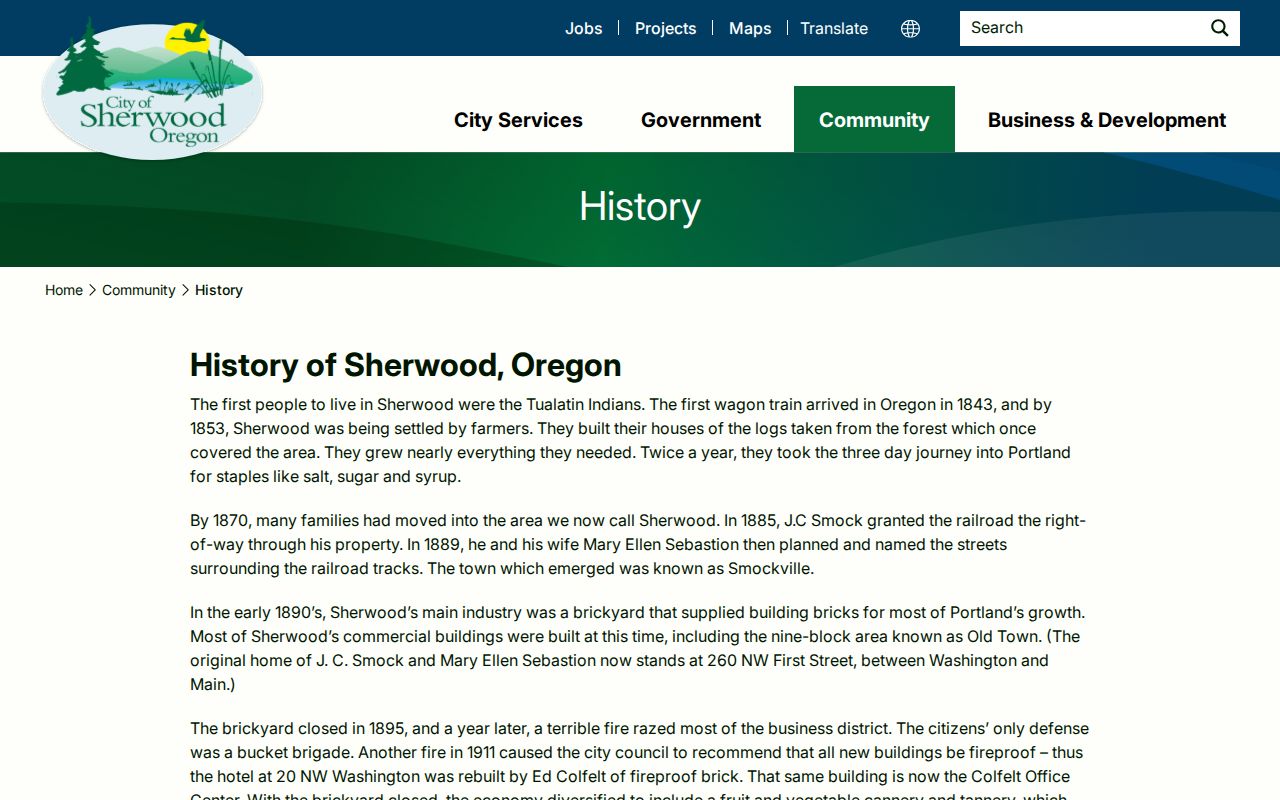
The history page is useful for place and time context, while the library catalog and an inspected volume remain the source for any claimed directory entry.
Search Sherwood, Smockville, and Tuality
A modern Sherwood search can miss older catalog language. The city history places J. C. Smock's railroad right-of-way in 1885 and the Smock and Mary Ellen Sebastion street plan in 1889, before the town was incorporated as Sherwood in 1893. The earlier town name was Smockville. At the county level, Oregon State Archives identifies the earlier Tuality District and its 1845 Tuality, now Washington County, census. Search Sherwood, Smockville, Washington County, and Tuality when a narrow modern filter produces nothing.
That name shift affects more than a keyword search. The Archives describes Washington County as one of the original counties of Oregon's legislative assembly, with its name and borders changing during the Territorial era. A catalog result under Tuality can therefore be relevant even though it does not display the current county name. Note every version used in a search log, then compare the date and geographic scope before joining it to a Sherwood family-history question.
The Washington County records guide is the official inventory gateway for that county history.
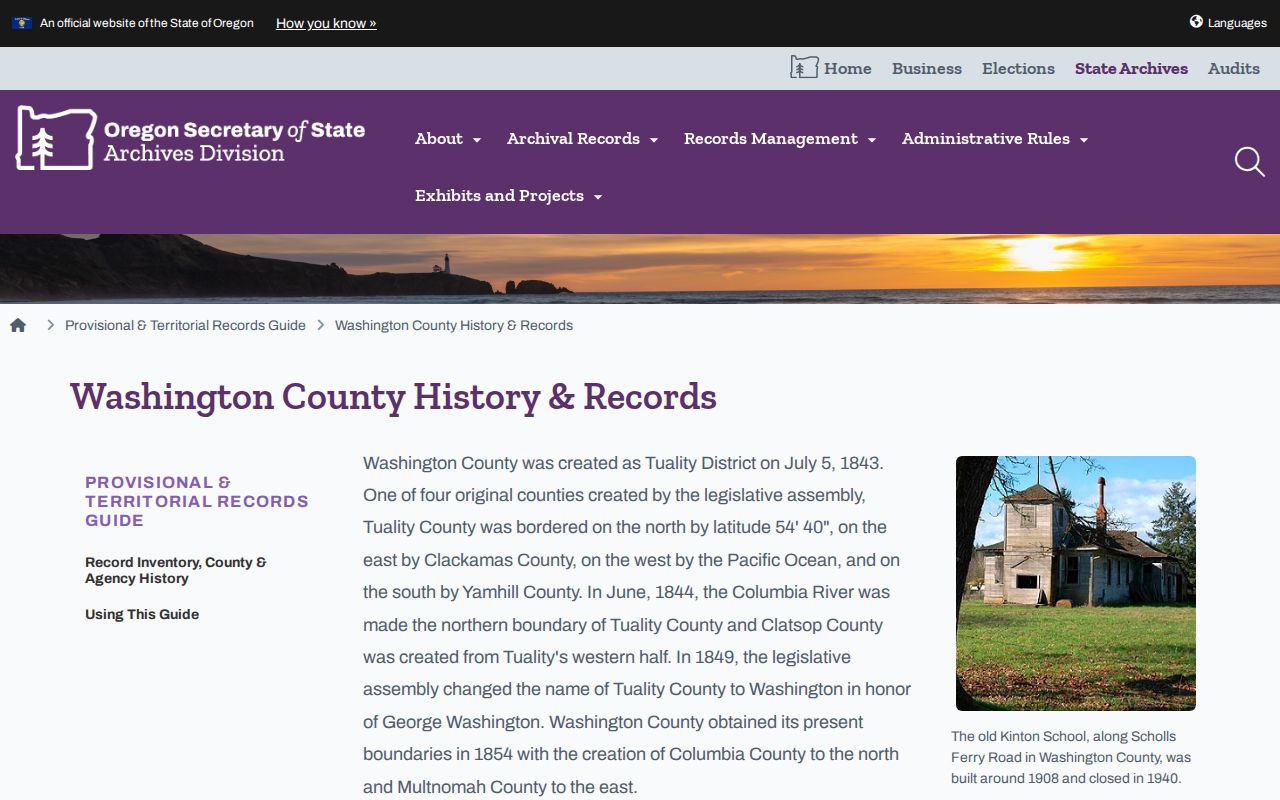
Its series descriptions can show a record's function, format, cutoff, and restrictions, which is better evidence than guessing that a nineteenth-century item was cataloged under a modern city name.
Read a Confirmed Sherwood City Directory Entry Carefully
No Sherwood volume was located and inspected in the research, so there is no verified local entry format to reproduce here. If staff confirms a volume, telephone book, or numerical directory, start with its title page and legend. A historical directory is a commercial compilation for a particular issue and geography, not a government roster. Its printed abbreviations and indexing choices control what the entry can mean.
| Title-page facts | Capture the publisher, issue date, geographic scope, and edition statement exactly as printed. |
|---|---|
| Printed name form | Record surname, given name, initials, spelling, and any relationship notation without expanding an abbreviation by guesswork. |
| Address reference | Transcribe the complete printed street reference and page or column, then test it against the volume's stated geography. |
| Section and legend | Note whether the item has an alphabetical, numerical, or street section and preserve the abbreviation key with the transcription. |
| Independent check | Compare the time-specific entry with an archival, census, deed, map, or permit source only after identifying the record's scope. |
- Criss-cross directory
- A directory organized from an address or street toward the printed listings, if that particular volume includes such a section.
- Householder index
- An index that names the person or household form used by the publication. Its coverage must be read from the volume itself.
- Abbreviation key
- The publisher's explanation of shortened terms and marks. Photograph or cite it before interpreting an unfamiliar entry.
What Sherwood City Directory Holdings Still Need Proof
The holdings gap is not a minor footnote. The reviewed official sources do not establish whether Sherwood appeared in a Polk volume, a Portland-area publication, a Washington County directory, a telephone book, or a reverse directory. They also do not establish any publisher, year span, last printed issue, digitized run, or specific microfilm cabinet. A claim about those details should wait for a librarian-confirmed catalog record and an inspection of the item itself.
Verification point. Ask for the title, publisher, issue date, geographic coverage, alphabetical or numerical sections, and access conditions before citing a Sherwood directory.
Washington County-area alternatives may be worthwhile leads, including historic directories digitized by the Forest Grove City Library and a subscription resource reported as available in county public libraries. Neither source proves it contains a Sherwood listing. Treat both as catalog questions, not substitutions for verified Sherwood coverage.
Trace a Sherwood City Directory Lead Through Time
Once an actual volume is confirmed, keep the historical trail anchored to the issue rather than turning one printed address into a present-day conclusion. The State Archives holds provisional, territorial, state, and federal census materials, including the 1845 Tuality census. Federal census releases currently extend through 1950 under the 72-year rule. Deeds, permits, probate material, maps, and notices can test a time-specific finding, but each answers a different question.
- Ask the library to identify a confirmed title and the exact Sherwood or Washington County coverage.
- Photograph or transcribe the title page, the abbreviation key, the page, and the entry exactly as printed.
- Make a year-by-year research sheet only for issues whose date and geography have been verified.
- Pair the resulting time band with the released federal census and any accessible territorial or state census material.
- Use a legal description, deed, permit, obituary, or probate record to test a move, a name change, or a disappearance from the printed source.
A blank issue does not prove that a person was absent. The publication may have changed its geography, schedule, rural-route treatment, or indexing rules.
Oregon State Archives as Sherwood's Historical Backstop
When a library catalog cannot resolve a family-history question, Oregon State Archives offers a defined fallback. Its archival vital-record research route accepts a name, event date, city, and Oregon county, and accessible material may be viewed free in the Reference Room. Research service, series restrictions, and copy rules still apply. The Archives guide is also the place to ask which original county series, microfilm, or publication may fit the question before traveling or ordering a record.
The Oregon State Archives vital-records research page shows the historical research channel.
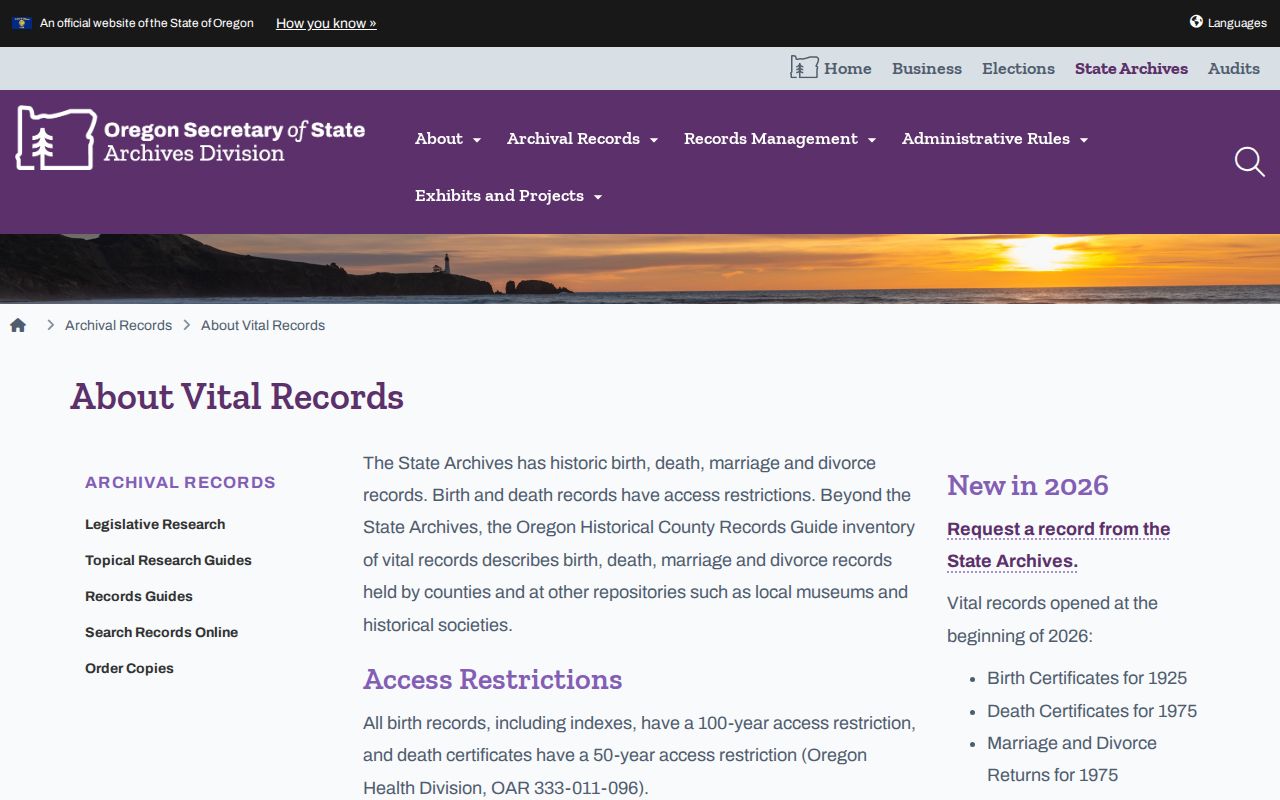
State Archives research can support a dated historical trail, but it does not fill the unverified Sherwood directory shelf list.
Test a Sherwood Printed Address With a Second Record
A confirmed printed address can be compared with a county marriage license, historical vital research, a property instrument, or a census only within the record's time and access limits. Washington County Recording handles marriage licenses and certified copies, while Oregon Health Authority and State Archives have different state and historical channels. Those systems are not interchangeable, and a recent certified vital record remains restricted by Oregon eligibility rules. The useful result is a documented historical connection, not a broad claim about a person's current circumstances.
The Washington County marriage-license page documents one county-held companion record.
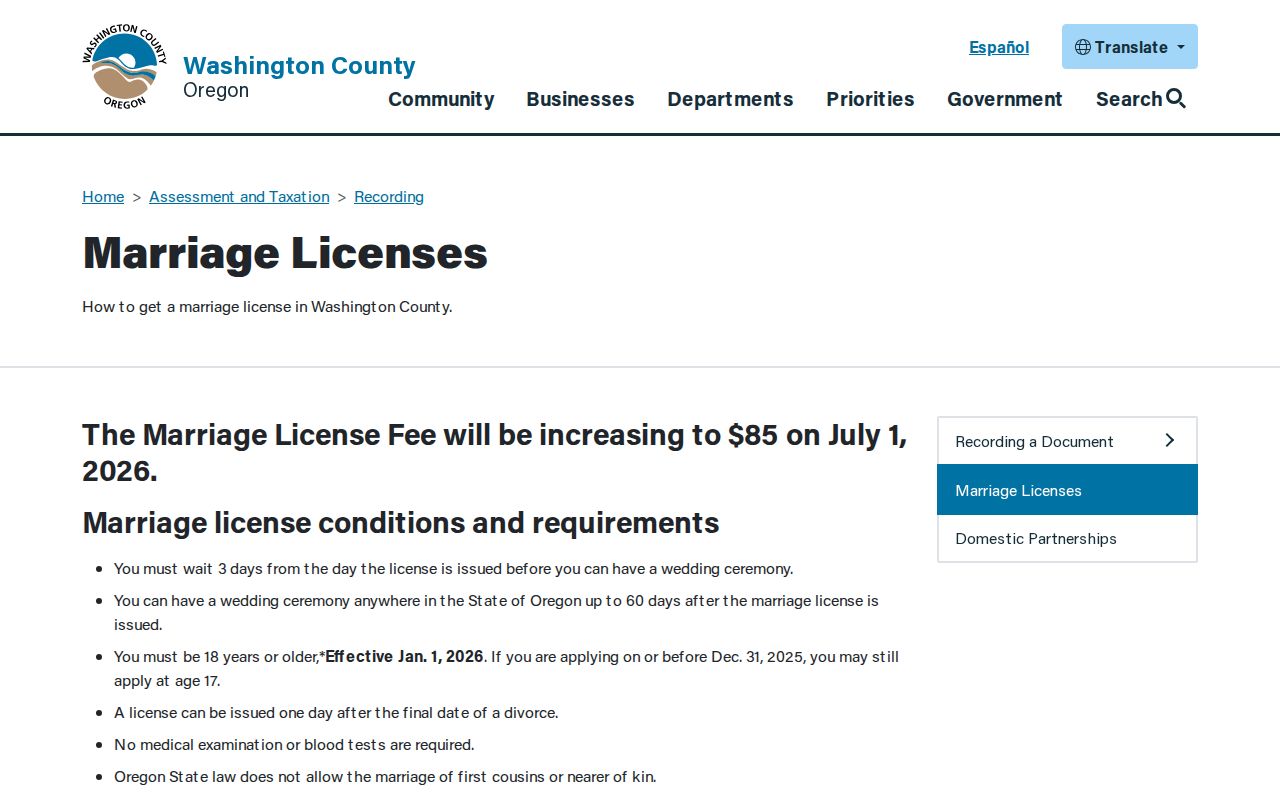
Use the county page for its own license and copy procedure, then retain the directory citation separately so the evidence trail stays clear.
Sherwood Records Must Separate Land From Buildings
Sherwood's record trail has a physical-history caution. City history reports that the 1896 fire razed most of the business district and that another fire occurred in 1911. A land instrument can therefore outlast the building it describes. For an Old Town question, pair any confirmed city-directory reference with historic maps, a survey or inventory, permits, and the county land trail rather than assuming that a long-running parcel description identifies the same structure. The Sherwood Heritage Center, Morback House Museum, and local historical contacts are inquiry leads, not verified directory repositories.